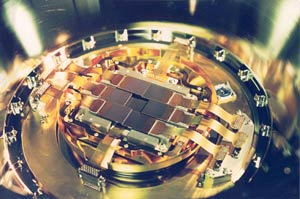
 The European Photon Imaging Camera (EPIC) is the main camera onboard
XMM-Newton. It can perform both
X-ray imaging and spectroscopy.
It is actually three cameras in
one, employing three different detectors to "see" X-rays.
The European Photon Imaging Camera (EPIC) is the main camera onboard
XMM-Newton. It can perform both
X-ray imaging and spectroscopy.
It is actually three cameras in
one, employing three different detectors to "see" X-rays.
The European Photon Imaging Camera (EPIC) is the main camera onboard
XMM-Newton. It can perform both
X-ray imaging and spectroscopy.
It is actually three cameras in
one, employing three different detectors to "see" X-rays.
The detectors are called "charge-coupled devices" or CCDs for short. They are similar to the detectors inside a common digital camera, but are sensitive to X-rays, not optical light. Two of the detectors are called "Metal Oxide Semiconductor" or MOS CCDs, and the other is called a p-n CCD. All three detectors can be used to create images of a target as well as take spectra.
They can also give a precise time when a given X-ray photon hits them. This allows astronomers to watch closely as astronomical targets vary in the amount of X-rays they emit. That information can be used to determine some of the physical characteristics of the source. The main difference between the MOS detectors and the p-n detector, in fact, is in the time resolution: the MOS can distinguish between two X-ray photons falling on it in an interval of 1.5 milliseconds, while the p-n has a much better time resolution of 0.03 milliseconds, or 30 microseconds! As a trade-off, the MOS detectors have a higher spatial resolution: they can distinguish objects about 1/4 the size that the p-n detector can.
The p-n CCD was built by the Max-Planck-Institut für extraterrestrische Physik (Garching) and the Astronomisches Institut Tübingen. It is made of a single wafer, a technology first for X-ray CCD astronomy. It is actually an array of electronic detectors, consisting of two rows of 6 chips with 64x200 pixels per chip.
The EPIC MOS detectors were put at the main focus of two of the three XMM telescopes (the third one being fitted with the EPIC p-n). Leicester University (UK), the University of Birmingham (UK), and CEN Service d'Astrophysique Saclay (France; the page is in French) participated in their construction. The are made up of 7 CCD chips of 600x600 pixels each, covering a field large enough to allow for the study of extended objects (like supernova remnants and clusters of galaxies).